
Where Light Meets Surrender : The Cyanotype Process
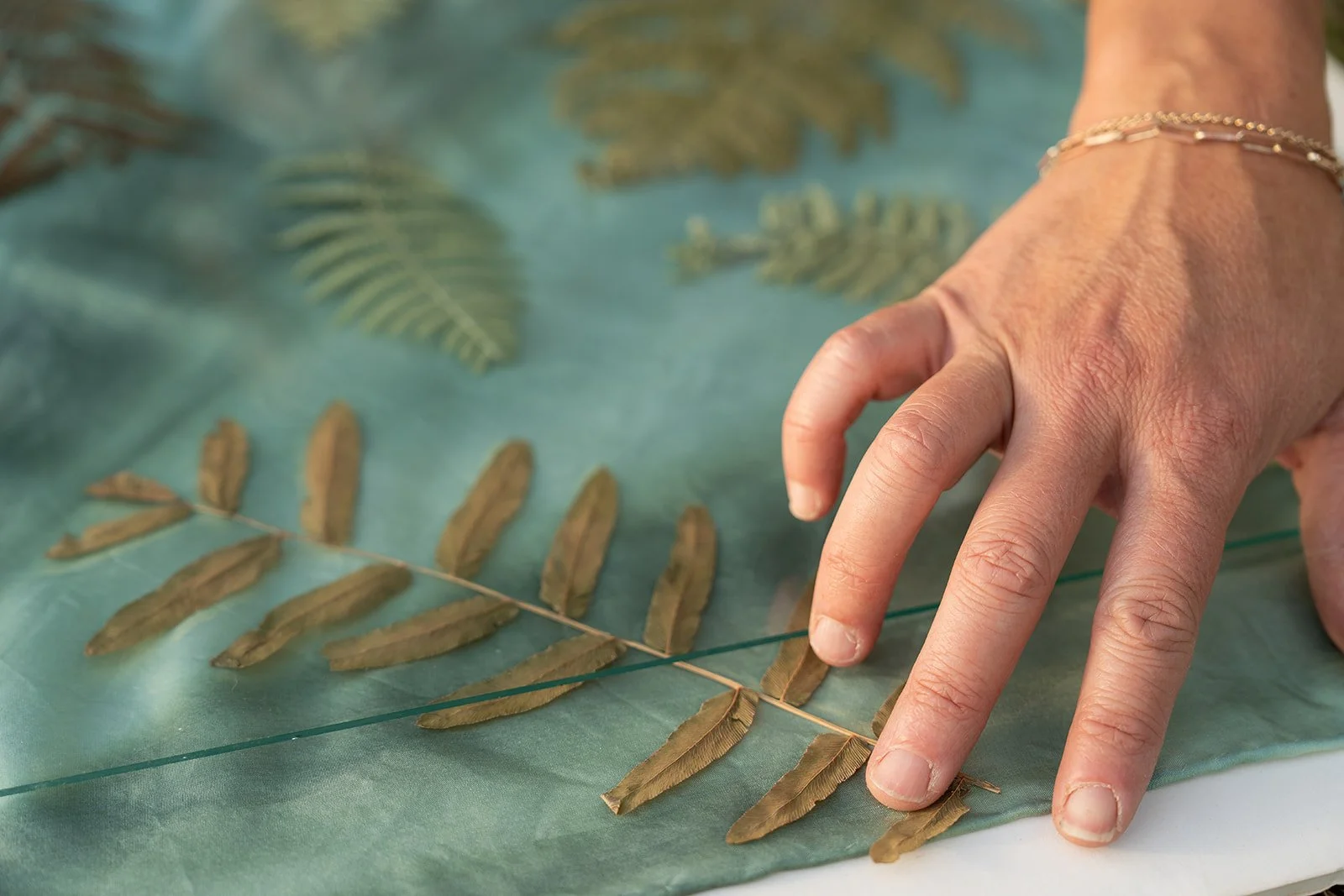
There is a moment in the cyanotype process that still feels like a kind of mystery to me. The fabric is coated by hand. The botanicals are arranged carefully, slowly. Everything is prepared, but nothing has fully happened yet. Then the piece is carried into the sunlight, and from there, much of the process is no longer in my control.
The light does what it will.
That may be one of the reasons I’m drawn to cyanotype in the first place. In a world that asks us to control outcomes, move quickly, and perfect every detail, cyanotype invites something entirely different. It asks for patience, attention and surrender. It asks us to participate instead of force. The process is beautifully unpredictable. And honestly, that unpredictability is part of what makes it feel sacred to me.
Cyanotype is one of the oldest photographic printing processes, invented by Sir John Herschel in 1842, it is known for its deep blue tones and the way it captures the delicate details of nature. Using a light-sensitive solution, natural fibers become a canvas for sunlight to leave its imprint. Botanicals, fabric, water, and light all work together to create the final image.
No two prints are ever exactly alike.
Some exposures become bold and high contrast. Others soften at the edges, fading like memory. Certain leaves reveal every vein in perfect detail, while others leave only a ghost of their shape behind.
Waiting is built into the art itself.
I think that’s why the process feels so deeply connected to the heart behind Selah Revival. The work asks me to slow down enough to notice what’s happening right in front of me. To pay attention to texture, shadow, season, weather, and timing.
To trust the unfolding.
Not every print becomes what I imagined when I started. Sometimes the most beautiful pieces are the ones I planned the least—the ones where the wind shifted a stem, or the light changed unexpectedly, or the water revealed something I could not yet see. There is a lesson in that.
Much of this work begins outside. Gathering leaves and wildflowers has become its own kind of practice—quiet, observant, rooted in paying attention. I’m constantly amazed by how much beauty exists in ordinary things once we slow down enough to really see them.
A single fern.
An overgrown stem.
The curve of a petal.
Creation is full of detail we hurry past every day. Cyanotype preserves those details in a way that feels almost reverent. The imprint left behind is not a drawing or imitation, but evidence that something real was there. Light records what it touches. There’s something deeply moving about that to me. For me, cyanotype is more than a creative process. It has become a reminder that some of the most meaningful things in life cannot be manufactured through striving. They unfold slowly, through patience and trust. Through allowing ourselves to remain present long enough for transformation to happen. Light develops the image gradually. Not all at once.
And maybe we are formed that way too.
Every piece created through Selah Revival carries traces of this process—the slowing, the waiting, the unveiling. Marks left by sunlight, water, the natural world and by time itself.
Made slowly.
Held in the light.
Created in the pause.